


 English
 Türk
Türk
SEARCH
HOT PRODUCTS
Newsletter
When Should A Manual Reset Capillary Thermostat Trip?
Safety engineers spend a surprising amount of time arguing over trip points, and for good reason, because a manual reset capillary thermostat sits at the exact spot in a heating circuit where a wrong setting either protects equipment or triggers nuisance shutdowns that frustrate operators. Getting the trip temperature right is less about a single number and more about understanding how heat actually moves through the system being protected.
Setting The Trip Point Against Real Load Conditions
Trip temperature selection starts with the equipment's normal operating range, then adds a margin wide enough to avoid false trips during ordinary load swings. A manual reset capillary thermostat installed on a water heater tank behaves differently than one mounted on an oil-filled space heater, since the thermal mass and heat-up rate of each system change how quickly the capillary bulb senses a runaway condition. Engineers working on tank-style appliances typically set the trip point tens of degrees above the expected operating temperature, giving normal thermostat cycling room to breathe without brushing against the safety limit.
Which factors push that margin wider or narrower? Response lag in the capillary tube itself is one, since the sensing fluid inside the tube takes a measurable amount of time to transfer heat from the bulb to the switch mechanism. A longer capillary run, common in larger tanks or remote sensing applications, adds a small delay that engineers account for by tightening the trip margin slightly, so the safety limiter still reacts before temperatures climb into a genuinely dangerous zone.
Why Manual Reset Matters At The Trip Point
The trip event itself is where a manual reset capillary thermostat separates from an auto-reset device in a meaningful way. When the bulb senses that the trip temperature has been reached, the internal switch opens the circuit and stays open, cutting power to the heating element regardless of what the temperature does afterward. This is deliberate. An auto-reset thermostat would simply re-close once temperatures dropped, potentially cycling a faulty heater on and off repeatedly without anyone noticing the underlying problem.
Are there situations where this distinction becomes critical rather than just convenient? Industrial dryers, commercial water heaters, and process heating equipment are common examples, since a repeated auto-cycling fault on this kind of equipment can mask a failing thermostat control, a stuck relay, or insulation breakdown for weeks before anyone investigates. Requiring a physical reset forces a technician to inspect the unit, identify what caused the overheat condition, and confirm the equipment is safe before power is restored.
Field Adjustment Versus Fixed Set Points
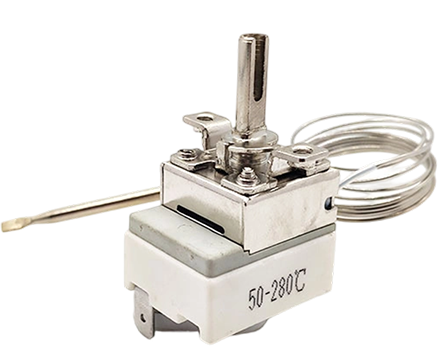
Some manual reset capillary thermostat models allow field adjustment of the trip point within a defined range, while others ship with a fixed, non-adjustable set point sealed at the factory. Where is each type typically specified? Fixed set point units tend to appear in mass-produced appliances where the manufacturer has already validated a single safe trip temperature across the entire product line, removing any risk of field misadjustment. Adjustable units show up more often in custom industrial installations, where the equipment being protected does not match a standard appliance profile and engineers need latitude to match the trip point to actual measured conditions.
|
Application |
Typical Trip Range |
Reset Type |
|
Residential water heater |
Fixed, factory set |
Manual |
|
Commercial dryer |
Adjustable within range |
Manual |
|
Process heating tank |
Field adjustable |
Manual |
|
Space heater |
Fixed, factory set |
Manual |
Verifying Trip Accuracy Over Time
Capillary thermostats do drift slightly with age, particularly after repeated trip cycles that stress the bulb and switch mechanism. Did testing protocols evolve to catch this drift before it becomes a safety gap? Periodic verification, usually done with a calibrated water bath or thermal chamber, checks that a manual reset capillary thermostat still trips within an acceptable tolerance of its rated set point. Facilities running critical process equipment often schedule this check annually, since a thermostat that has drifted even a few degrees off its original calibration reduces the safety margin the entire system was designed around, and replacing a drifted unit is a far smaller cost than the equipment failure it was meant to prevent.
OUR PRODUCTS
Recommended Products



PLEASE LEAVE YOUR SPECIFIC REQUIREMENT

QUICK LINKS
PRODUCTS
CONTACT
-
+86-15957748531
+86-15558959105
+86-19588099846
+86-18815077137 -
jilly@wzleh.com
east@wzleh.com
scott@wzleh.com
kim@wzleh.com
ADDRESS
- STI Park #B-2, Hongqiao Yueqing City, Zhejiang, China, 325608


Leheng Thermostat Factory
Copyright © Wenzhou Leheng Technology Co., Ltd. All Rights Reserved.